Opublikowano — Dodaj komentarz

The non-existent St. Margaret's Church in Netta

Both the beginning and the end of the calendar year make us reflect on life and the passing of our existence on earth. However, we do not often reflect on the fact that the space around us is changing as well. This also applies to architecture, including sacral one. For centuries, in the Bargłów parish, there hasn't been a St. Margaret's Church in Netta (now Netta Pierwsza).

Earliest references

Józef Golubiewski, an insightful chronicler of Bargłów, in the Chronicle of the royal parish of Bargłów notes out of some documents three pieces of information about the existence of a church in Netta. The first one is taken from a letter from King Zygmunt August of 1561, the second one from 1700 and the third one from the church inventory written down in 1783. Traces of the existence of the church in Netta have been preserved in very few documents and publications, and in the memory of some villagers.

In his work "The History of Settlement in Augustów County from the 15th to the end of the 18th century", a historian Jerzy Wiśniewski gives the local name of the hill "Kościółek" (little church) and supposes that a branch church of the Bargłów Temple could have stood on it. While I was looking for traces of this place in September 2006, most of the people I asked, had not heard about the existence of a church in Netta. Someone anonymous directed me to the Augustów Canal, where I met Tadeusz Połubiński who pointed me exactly to the hill where the church stood and shared his information with me.

Built by Jan Radziwiłł

While working on the sacral monuments of Bargłów Kościelny, I got acquainted with the parish documentaries copied by Józef Golubiewski. These included, among others, a copy of a letter from King Zygmunt August dated December 1561 to a Bargłów Pastor Tomasz Bohdan Szaciła (in the List of the Parish Priests and Administrators of the Bargłów parish, Józef Golubiewski mentions him as the first parson in Bargłów). In this letter, the ruler assigned Pastor Szaciła a church in Netta with the land in the amount of three voloks, three morgens and two square rods. It appears from the letter that this church, called in the document kościołek (a small church), was built by Jan Radziwill. The letter was written at the request of the vicar. It was supposed to provide the rectory with these lands as its own for eternal times. I' m quoting their location from the copy: w Wołosty naszoy Korolewskoy w obrubie wsi Netty [..] lezaszczyie w koncu wolok naszych koncom –do Rzeki Netty a bokom podle wolok Nettowskich (Our royal voloks are around the Netta village […] lie at the ends of our voloks, ends – to the Netta river and sides towards Netta’s voloks). The parish priest's only duty was to hold a service in the church every day: kromie tolko Nabożeństwa każdo dziennocho tak on sam, jako i następcy Pilnie powinni czyniti (besides this, he, as well as his successors, should diligently hold a mass every day). The year of construction of the church is unknown. Netta, formerly known as Meta, was founded around 1532 by a Mazovian, Maciej Srebrowski from Srebrov near Wizna with the authorization of Jan Radziwill, a Lithuanian cupbearer. Most probably, the private church of the Radziwiłłs was established after the founding of the Meta, and before the incorporation of the area into the royal estate and before the establishment of the parish in Bargłów in 1544. Previously, these areas belonged to the parish in Rajgród. Whether it was originally a branch church of the Parish of Rajgród is not entirely known. Józef Golubiewski in the chronicle calls it prywatny kościółek (a private little church). Later documents show that it was erected as the church of St. Margaret.

The Swedish war wreaked great havoc on the lands of the parish of Bargłów. The following churches were completely destroyed: the parish church in Bargłów and the private church in Grabów parish. The church in Netta survived the war turmoil and in 1700 was listed as the only church in the area. A historian Jerzy Wiśniewski mentions that: The branch church of St. Margaret in Netta was in a better condition. However, it is likely that the war undermined its later glory and contributed to its downfall. During the Swedish Deluge, the village of Netta was severely damaged and people were impoverished. A historian Jarosław Szlaszyński, on the basis of materials from the State Lithuanian Archive in Vilnius, reports that Netta has been completely destroyed by fire with only four empty cottages left.

Temple’s appearance

The description of the church can be found in a document issued on the occasion of the general dean's visitation of the parish of Bargłów in March 1783. It was situated half a mile from the Bargłowski church. It stood on an uphill stretch near the forest, 30 furlongs away from the village of Neta. It was described as ravaged, unrepairable and, as a result, unfit for service. It was made of wood. It had two doors and five windows. One double door, on iron hinges with the inner lock from the cemetery, the other one to the sacristy also on iron hinges with two hasps and a lock (z dwoma Proboiami y Skoblem). The windows were lead-framed. Four of them were in the church and one in the sacristy. The floor in the church was made of lumber. The church was equipped with a pulpit, two benches and an altar with a painting of St. Margaret. Above the church porch, there was a dome with a bell, topped with an iron cross. The Church, as the surveyor Father Szymon Pienczykowski writes, w cało spustoszony, tak w Dachu, Scianach iako y we Wnętrzney Ozdobie (is completely ravaged, equally in the Roof, the Walls and the Interiors). The floor in it was rotten while the windows were broken and the equipment was decayed. It was not suitable for holding masses, yet they were still held there. According to the old custom, it was used for four masses a year: on St. Margaret´s Day, the second day of Christmas, the second day of Easter and the second day of Green Week. The parish's description states that according to tradition, the church was erected under the new name of St. Margaret's. Near the church there was a cemetery, described on the occasion of a visitation: a graveyard that was once fenced.

The land belonging to the church was cultivated by the Bargłowski presbytery. The church documents from 1822 and 1832 state that the voloks in the village of Netta were handed out by the predecessors by private agreement to the landowners who lived in their own houses. The names of those living in their own cottages were also given. In 1822 these were: Maciej Dudek, Jan Drozd, Tomasz Romanowski, Piotr Szymański and Jan Gulan. Ten years later, the following names: Jan Drozd, Kalisz (without a name), Antoni Gulan, Andrzej Kościuch and Mateusz Karp were mentioned.

What happened to the church?

In the protocol of the General Visitation of 1822, signed by Pastor Jan Kanty Zawadzki and the Dean of the parish of Wąsów, Father Modzelewski, it was written that there were no public chapels in the parish. The church from Netta was also not mentioned in it. One can think that at that time the church of St. Margaret in Netta did not exist anymore. It was probably disassembled and the remains were, following tradition, burnt just as it was done with rotten crosses.

Irena Baturowa in her article about Netta-Folwark published in "Jaćwieża" also mentions a hill in Netta Pierwsza where the church of St. Margaret once stood. She reports that there was a spring at the foot of the hill whose water cured eye diseases. According to the legend she quoted, one time a rich lady washed her blind dog's eyes with the water from the spring and the water lost its healing powers.

My local guide to Kościółek (the Church Hill) told me that he remembered from the stories of his ancestors that in the 19th and early 20th century a wooden cross stood on the hill. Until recently, bones had been ploughed out of the hillside confirming the existence of a cemetery there in the past.

I believe that it is worth keeping in mind the existence of the church in Netta. We need to continue looking for more information and, thus, answers to numerous questions related to it. For instance, who canonically erected this church and why St. Margaret was chosen as its patroness?

Wzgórze Kościółek, wrzesień 2006. fot. Józefa Drozdowska
Wzgórze Kościółek (The Church Hill), September 2006, Photo by Józefa Drozdowska.
Opublikowano — Dodaj komentarz

Epidemia dżumy w dobrach Raczki w latach 1710-1711

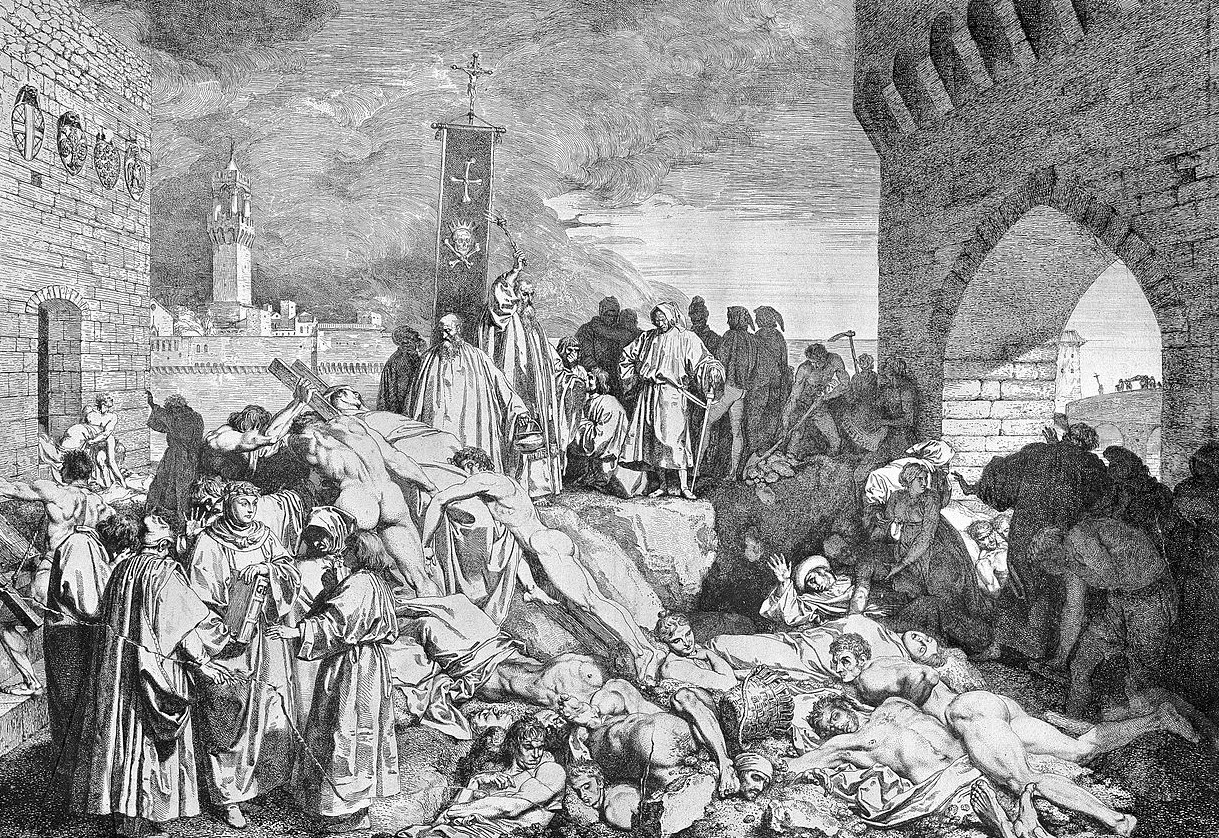
Od zarania dziejów epidemie chorób zakaźnych i śmierć na Suwalszczyźnie kroczyły w parze. Plagą tych terenów były nader częste pożary, wojny i przemarsze wojsk (szczególnie podczas Potopu szwedzkiego), z którymi wiązały się mniejsze i większe ogniska chorób zakaźnych. Nadmienić należy, że następstwem suchych lat i ostrych zim był nieunikniony niedobór żywności, który w połączeniu z nieprzestrzeganiem jakichkolwiek zasad higieny (mistyczny kołtun i ropiejące wrzody), doprowadzały do przedwczesnej, często głodowej i strasznej agonii. Podczas klęsk żywiołowych i nieurodzajnych lat miejscowa ludność pochłaniała wszystko, co nadawało się do spożycia, np. korę brzozową przerabiano na mąkę, a jedzono nawet trawę, koniczynę i perz, nie wspominając o wszelkim upolowanym ptactwie (bociany, gawrony, kawki, dzikie gołębie), gryzoniach, domowych zwierzętach (psy i koty) i owadach. Niewykluczone są również przejawy kanibalizmu. Najtragiczniejsza w skutkach epidemia dżumy, zwanej czarną śmiercią, trwała od roku 1709 do lat 20. XVIII wieku i zdziesiątkowała miejscową, wyczerpaną głodem ludność. Niektóre ze wsi na Suwalszczyźnie wymarły w stu procentach, inne w ponad 80, jeszcze w innych zostali sami schorowani i wymagający opieki starcy oraz wdowy. Zaraza wyjątkowo roznosiła się „powietrzem” na terenach otwartych, we wsiach nieosłoniętych lasami lub nieoddzielonych od innych osad akwenami wodnymi. Ponowne osadnictwo dóbr zajęło kolejne, nadal niepewne i nieurodzajne dziesięciolecia.

W archiwum parafialnym parafii pw. Zwiastowania Najświętszej Marii Panny w Janówce możemy odnaleźć rejestry zgonów w dawnej parafii Janówka, a także wzmianki o pomorze w dobrach Raczki i tej samej parafii, które miały miejsce podczas wielkiej epidemii w latach 1710-1711. Szalejąca głównie zimą 1710/11 roku epidemia dżumy zwana wtedy „powietrzem morowym„, była największą katastrofą demograficzną w dziejach współczesnego osadnictwa na Suwalszczyźnie, od pierwszej połowy XVI wieku, do czasów nam nieodległych i pandemii grypy zwanej popularnie „Hiszpanką”. Hekatombę z początku XVIII wieku mylnie wiąże się z epidemią cholery, która była zabójcza ponad sto lat później, lecz na znacznie mniejszą skalę. Słabsze ogniska pomorów dotyczyły również innych zabójczych chorób – czerwonki, a także gruźlicy (zwanej niegdyś suchotami).

Spis ofiar zarazy w miejscowości Janówka do wiadomości kolejnych, choć niewielu ocalałych pokoleń miejscowych rodów podaje się w słowach: „Summa facit ludzi pomarłych we wsi Janowie No sto dziesięć. Imć Xiądz Jan Sucharzewski, pleban Janowski, wymarł z ludźmi dwudziestą sześć. Zostało się gospodarzow dworskich w teyże wsi Janowie – dwa. Gospodarz z żoną ieden Plebański, gospodarz ieden y wdów dwie. Karczma janowska tak ze stodołami iako y spichlerzem, zgorzała funditus, przez co vacat.„. O wielkiej zarazie świadczy również tablica pamiątkowa ofiar dżumy, zainstalowana w kościele janowskim. W roku 2008 podczas prac na wyrobisku żwirowym w Janówce odkryto kości należące do 22 osób będących w różnym wieku obojga płci. Dochodzenie i ekspertyza wskazywały na ofiary dżumy, jednakże mało prawdopodobne jest, iż ofiary tej choroby chowano w trumnach, których szczątki również wydobyto. Prawdopodobnie w miejscu tym istniał stary, wiejski cmentarz grzebalny, przeznaczony nie tylko dla ofiar ognisk zarazy, ale przede wszystkim biedocie (z przyczyn „ekonomicznych” nie wszyscy byli chowani na cmentarzu parafialnym) i ludziom wyznań mniejszości religijnych. Do niedawna sądzono, że winowajcą za szybkie rozprzestrzenianie się zarazy były szczury, ale najnowsze badania wykazują, że to nie znienawidzone gryzonie były głównymi roznosicielami choroby, a wszy i pchły. Zatem wracając do punktu wyjścia, jakim jest głód i choroby, to higiena będąca wielkim wrogiem ówczesnych włościan, zamknęła błędne, śmiertelne koło.

Poniżej przedstawiono sporządzony spis poepidemiczny ofiar epidemii w „dobrach Raczki i Szczodrucha„: Małe Raczki zwane wsią Raczki, Bolesty, Witówka, Lipówka, Wasilówka, Wierciochy. Rejestr ofiar w poszczególnych rodzinach gospodarzy: Continue reading Epidemia dżumy w dobrach Raczki w latach 1710-1711

Opublikowano — Dodaj komentarz

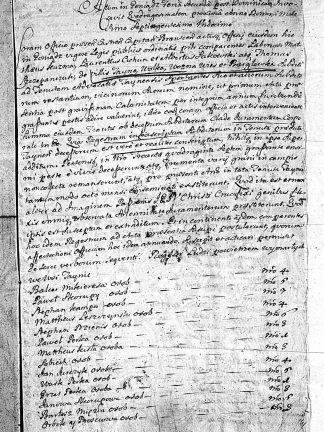
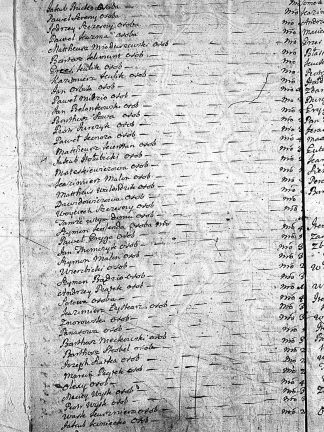
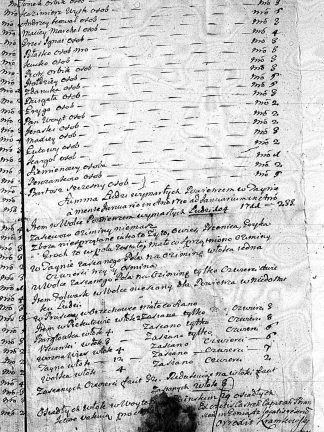
Rejestr ludzi powietrzem wymarłych we wsi Tajnie z 1711 roku

Rejestr osób wymarłych z powodu powietrza we wsi Tajno został sporządzony w Goniądzu w poniedziałek najbliższy po I Niedzieli Wielkiego Postu przez Kapitana Branscena oraz uczciwych Macieja Kuźmę, Wawrzyńca Ciechuna i Wojciecha Sakowskiego oraz Tomasza Szczepańczuka ze wsi Tajno, Wólka, Woźnawieś i Bargłówka. Spis dotyczy osób z gospodarstw domowych zmarłych w 1710 z powodu dżumy.

Balcer Mikieresa osób 4
Paweł Skorupa osób 5
Stefan Kampa osób 7
Mateusz Leszczyński osób 4
Paweł Perka osób 3
Stefan Dzienis osób 6
Mateusz Kisła osoba 1
Sobiech osób 3
Jan Jurczyk osób 4
Waśk Perka osób 5
Grześ Perka osoba 1
Janowa Skorupowa osób 3
Bartosz Mięzia osób 5
Orbik and Prościowa osób 3
Jakub Bućko osoba 1
Paweł Sereny osoba 1
Jędrzej Szczesny osoba 1
Paweł Kuźma osoba 1
Mateusz Mioduszewski osób nieczytelne
Bartosz Klimunt osób nieczytelne
Grześ Kulik osób nieczytelne
Kazimierz Kulik osób nieczytelne
Jan Orbik osób nieczytelne
Paweł Miezio osoba 1
Jan Bołonkowski osób 2
Bartosz Sowa osób nieczytelne
Piotr Jurczyk osób 2
Paweł Konoza osób 3
Mateusz Kierstan osób 3
Jakub Hołubicki osób 3
Mateskiewiczowa osób 2
Kazimierz Malon osób 5
Mathias Walendzik osób 2
Dawidowiczowna osób nieczytelne
Wojciech Szczesny osób nieczytelne
Tamże w tym domu osób nieczytelne
Szymon Kolenda osoba 1
Paweł Grygo osób 4
Jan Thomczyk osób 5
Szymon Malon osób 3
Wierzbicki osób 3
Syzmon Bądzio osób 2
Andrzej Piątek osób 3
Sotowa osoba 1
Kazimierz Łyskarz osób 4
Znorowski osób 3
Panasowa osób 3
Bartosz Nieckowski osób 5
Bartosz Skobel osób 3
Józef Siarka osób 2
Marcin Piątek osób 2
Oleksy osób 2
Maciej Wysk osób 4
Piotr Wysk osób 3
Wask Kusznierz osób 3
Jakub Koniecko osób 2
Tomek Orbik osób 4
Kazimierz Wysk osób 3
Andrzej Kowal osób 5
Maciej Marchel osób 3
Grześ Ignat osób 4
Błasko osób 3
Kućko osób 3
Piotr Orbik osób 3
Hołdziej osób 3
Zdanuka osób 5
Durgała osób 5
Grygo osób 3
Pan Wójt osób 2
Jeraski osób 2
Madzej osób 2
Gutowy osób 3
Kargol osób 2
Siemienowy osoba 1
Perczankow osób 2
Bartosz Szczesny osób 5

Suma ludzi wymarłych powietrzem w Tajnie od stycznia 1710 do stycznia 1711 - 233.

Opublikowano — Dodaj komentarz

Our folks in Turkestan

When registering marriage certificates, civil registrars often indicated the place of origin of the bride and groom. Until the First World War, migration of the population was not very common. That is why, the majority of newlyweds came either from the parish where the marriage register was from or from neighbouring parishes. Occasionally, there were people from further away. People coming from the deep ends of the Tsarist Russia were even less frequent. The population movements, however, took place in both directions. Inhabitants from areas of our interest were found in the Far East – moving there either voluntarily or being taken away by force.

The gallery of wedding certificates of people found in the parish in Turkestan (the area of today's Kazakhstan) is shown below. Here is the list of them:

  • 1901/3 Rozalia Radkiewicz (c. Macieja i Marii) z guberni suwalskiej (ślub we Włodzimierzu)
  • 1901/4 Weronika Marchel (c. Wincetego i Rozalii z d. Lutyńskiej) z Suwałk (ślub w Niżnym Nowogrodzie)
  • 1905/18 Anna Witkowska (c. Dominika i Franciszki) z parafii Szczebra (ślub w Aszchabadzie)
  • 1906/14 Magdalena Blaszko (c. Jana i Anny z d. Pieńkowskiej) z parafii Rydzewo (ślub w Taszkencie)
  • 1906/32 Natalia Rogowska (c. Jakuba i Petroneli z d. Górskiej) z parafii Bargłów
  • 1908/44 Wiktoria Lis (c. Piotra i Elżbiety z d. Biełous) z parafii Sylwanowce (ślub w Taszkencie)
  • 1910/4 Marianna Osowska (c. Franciszka i Katarzyny z d. Gil) z powiatu augustowskiego (ślub w Jekaterynburgu)
  • 1913/37 Roman Marcinkiewicz (s. Józefa i Marii z d. Dobrowolskiej) z parafii Bargłów (ślub w Taszkencie)
  • 1914/5 Franciszek Siedlecki (s. Jakuba i Katarzyny z d. Jacewicz) z guberni suwalskiej (ślub we Władywostoku)
  • 1915/35 Zuzanna Skwarko (c. Stefana i Józefy z d. Sosnowskiej) z Goniądza (ślub w Irkucku)
  • 1915/36 Bolesława Maliszewska (c. Kajetana i Dominiki z d. Trockiej) z Augustowa (ślub w Irkucku)
  • 1916/9 Maria Smykowska (c. Wincentego i Julii z d. Burakiewicz) z parafii Krasnybór (ślub w Taszkencie)

and the death certificate

1903/22 Kazimierz Maciukiewicz z Suwałk (zgon w Turkiestanie)

It is not a complete list and it is certainly worthwhile to search in detail the metric resources of the Roman Catholic Church in Russia available in  Sankt-Petersburg archives. People from the entire area of the former Republic of Poland can be found there, but we are particularly interested in people from "our" region.

This incredible discovery was made by Magda Wróbel. Thank you for sending us the materials!

Opublikowano — Dodaj komentarz

Studzieniczna

Probably everyone has heard about the Sanctuary in Studzieniczna, today a settlement in the administrative part of Augustów. At the beginning of the 18th century, on one of the islands of Lake Studzieniczna, there was a hermitage in which a monk from the Camaldolese monastery in Wigry lived. The hermitage was in the place "famous for miracles", which is reportedly testified by a visit of the Augustów deanery from 1700. Former Polish army officer Wincenty Murawski, aka Morawski, settled there. Murawski was an herbalist and apparently the water from the well he dug had healing properties, in particular it helped with eye diseases. On the island there was a copy of the image of Our Lady of Częstochowa, initially the painting hung on an oak, and later in a wooden chapel built by Murawski. In 1782, Murawski made a pilgrimage to Rome, where he obtained the right to four complete indulgences per year, with the most important one for Pentecost, next on July 26 for St. Anna, May 16 for St. Nepomuk and September 23 for St. Tekla. He also brought pictures of saints, which he placed in the chapel. Currently, there is a stone chapel there, built in 1872 by Ludwik Jeziorkowski, engineer of the Augustów Canal. The chapel's foundations are based on 64 oak piles driven into the ground. At the end of the 19th century, a dyke connecting the island with the mainland was built. The indulgence ceremonies are held in Studzieniczna to the present day, and just before the war the indulgence on Pentecost lasted three days. During the penultimate pilgrimage to Poland in 1999 Studzieniczna was visited by Pope John Paul II, there is a monument where he got off the ship to the shore.

An interesting description of such pilgrimage ceremonies was published in 1931 by the "kurier Warszawski" journalist, writer and columnist Julian Podoski. Born near Zamość, and associated with these areas through his father, Tadeusz Podoski, who was the first commissioner-governor of the Augustów poviat from November 1918 to November 1919. Julian published in "Gazeta Augustowska" for several months, and literally got married with Augustów, marrying in 1931 with Zofia, daughter of the Augustów physician Jan Jaworowski. Podoski's articles about Augustów and the surrounding area were published in "Kurier Warszawski" in the years 1929-1938. Julian Podoski was a friend of Kornel Makuszyński and Marian Walentynowicz. Together with the latter, he drew comics for the "Świat Młodych" in the 1940s and 1950s. Among the columnists writing about these areas is also Karol Hoffman, Ferdynand Ossendowski, Bronisław Stefanowski writing under the pseudonym Stefan Stojan and several others. The following column is one of several dozen texts describing the history, customs and everyday life of the inhabitants of the so-called Northern Borderlands (i.e. Augustów, Raczki, Suwałki, Sejny, Grodno) from 1919 to 1939. Probably in July our next book titled "Augustów, Suwałki, Sejny, Grodno and the borderland 1919-1939. Columns of correspondents of Kurier Warszawski" will be published, numbering over 400 pages and richly illustrated with archival photographs. Also at this time, we plan to issue a reprint of the guide "Pojezierze Suwalsko-Augustowskie" from 1937, the book is being created in cooperation with the University Library of Jerzy Giedroyć in Bialystok.

In Studzieniczna

Indulgence at Pentecost in Studzieniczna - At the well at which the figure of the Blessed Virgin Mary appeared - Through dam to the chapel - Prayers in a wooden church - Pilgrims at the foot of the chapel on an islet - Burning candles and pilgrimage on the knees - Graces of the Holy Virgin from Studzieniczna - Beggars - A friend from Warsaw - Vendors - "Cold ice water" and bagels - And when the third day of the indulgence ends ...

Studzieniczna, in May

It was warm, May rain at night. In the morning, on the first day of Pentecost it cleared up completely. In the streams of hot sun, in a downpour of golden rays, the swarm of people of Suwałki region goes to the annual indulgence, in Studzieniczna, in the poviat Augustow. Hundreds and thousands of wagons, carts, vans and carriages are heading in the same direction - towards the miracles of the famous chapel on the island of Lake Studzieniczne. According to ancient tradition, the Mother of God was to appear at the well, and at the same time began to heal the sick and the cripples. Miracles multiplied. The news of the place, famous for miracles, spread more and more widely. More and more believers began to converge on all sides of the Suwałki-Augustów lakes, forests and villages. As the years went by, when extraordinary phenomena continued, a three-day indulgence was announced here.

Studzieniczna lies among the forests, where the Białe and Studzieniczne lakes are adjacent. From the island where the miracle happened for the first time, a dyke leading to the wooden church and the neighboring village of the same name was built. On the island itself is a white, stone chapel and a well, next to which the figure of the Mother of God was placed, in the place where she was supposed to appear on that fateful day.

Now, not only the islet, dike and area around the church, but the space of several kilometers of forest is occupied by pilgrims and their camps. The crowd of people sways and vibrates, pouring in two streams at the feet of the image of the Blessed Virgin and pouring from them.

Local people prevail. However, there is also a lot of intelligence.

Fourteen priests who came to the area cannot keep up with religious services. The crowd is squeezing more and more , although masses are celebrated without interruption. Thirsting for grace comes constantly. At times, it seems that the fence of the church graveyard will not withstand the pressure of the people and shatter soon. The smell of burning incense and the sound of silver bells flows from the crowded interiors of the temple.

The door to the islet's chapel is wide open. Those who want to experience grace or thank for the experienced grace kneel or lie prostrate at the altar.

After saying a short prayer to allow further waves of pious people access to the temple, people approach the church grandfather, who "leases" wax candles. Later, those who give thanks or are just asking for mercy in earthly pain or distress come out. According to their vows, they circle the chapel three times, being careful that the flames don't go out. Many of the pilgrims come to this wonderful place on their knees.

Dozens of men and women look weird in the scorching sun gloomy in prayers, full of fervent faith in a miracle to come true!

Apparently, the Mother of God in Studzieniczna is kind to these miserable people, because half of those present are those who have received grace.

The chapel in Studzieniczna is surrounded by lake waters everywhere. Behind the water, the dark wall of pine forests glistens in the sunny heat. Among the tall trees, the "shingle", a wooden parish temple, prays with the people.

Not only did the pious come to a wonderful place. Every free corner is full of professional beggars. There is such a multitude and variety of them that you will get confused soon. Moreover the beggars are not embarrassed and they push the image of their disability as close to the pilgrims' eyes as possible to stimulate the homies to sacrifice. There are shouts and screams in various tones, intended to increase the pity of those who do not beg ... The most terrible stumps and wounds were put on public display ... Deaf-mute stimulate the sensitivity of pilgrims by ringing the bells or clappers.

By looking at this cluster, you can immediately distinguish two species of beggars. The first is - village louts of all varieties and shades. A collection so rich that more than one ethnographer would have a lot to do here, finding types that reach back to a distant space of time. The second type is "smart". Various "cripples" with faces on which, under the mask of piety, hide eyes glistening with... insolence, their pupils fly anxiously and vigilantly. Each of these ladders has a helper, from time to time he moves closer to the "patron" and raises some of the beggar's gifts in nature, so that they do not stab too much in the eyes of further donors...

Among other things, on the dam, right by the lake, in the shadow of a trembling aspen I met an old friend. Not only I know him, but all Warsaw also knows him! He stands all autumn and winter, or rather he sits on a sheet in front of the church of St. Cross. A plaque is hung around his neck: "Deaf from birth". He draws public attention here with the same bell he uses in the capital on Krakowskie Przedmieście Street. When I recognized him and came closer to take him into the camera's viewfinder, he shook restlessly. Maybe he met me. After all, I passed by him so many times, returning from the editorial office!

The three-day indulgence in Studzieniczna has fame established by cohorts of beggars and traders. The former managed to squeeze into the cemetery fence and just near the chapel, famous for its miracles. The traders are more modest. They quickly founded improvised stalls along the main trail leading to the gate in the church fence. They sell everything! Even the ladies from the capital who went to Studzieniczna for the indulgence do not hesitate to put glass "pearls" on their neck for ... 60 grosz per meter string! Bicause: "If you fell among crows, croak like them" ... The cries of the vendors lure amateurs: "To water, to water ... Sweet, cold, ice, better than Jewish soda!" And such nectar consists of ... a bucket of cold water from the lake, a quart of "natural fruit" vinegar, half a pound of fine sugar, and other additions that come to "lemonade" from all parts of the world, in the form of flies and various other insects. You can strengthen your weakened physical condition with... excellent sausage, dried for a year and so hard thatyou can confidently use it for... thumps for threshing grain... You can bite it only with the help of pliers, a saw and a chisel ... The flower of the indulgence trade, however, are dryers. Various! And these really are excellent.

The screaming and encouragement of the stall keepers sound until late at night. And when the evening falls and the last day of the indulgence ends, it gets emptier and quieter around. The crowd disappears quickly. All that is left is the forest, the rustling of the evening prayer and the belated pilgrims who lie prostrate at the foot of the wonderful chapel and repeat the words of faith stubbornly:

"After all, you will heal me, Blessed Virgin Mary of Studzieniczna, because the goodness of our Lord, Heavenly Father, is so infinite that nothing can be denied to Mother of Jesus from Nazareth. Amen!"

Julian Podoski

Opublikowano — Jeden komentarz

Difficult Memories

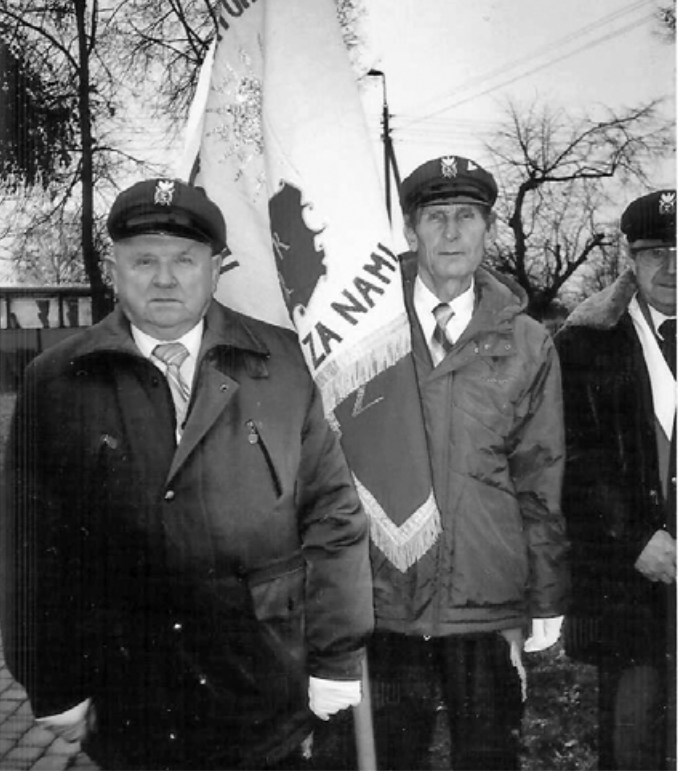
Edward Orbik (trzyma sztandar).

Childhood is probably the most carefree and happy period in everyone's life. Looking at my younger sister, I can say it with all firmness. I like to look at photos from my childhood. Recently, looking at family photos, I came across a photo of my grandfather. The photo was taken at our school in Netta on February 11, 2008. It was another anniversary commemorating the deportation of the inhabitants of the village of Netta Folwark to Siberia. Grandfather stood proudly in a middle and was holding the banner of the Association of Siberian Deportees, Augustów Division. I know that my grandfather was a Siberian Deportee and always took an active part in all commemorations of all those who stayed in this inhuman land. I decided to learn more about my grandfather and his childhood spent in distant Siberia. Unfortunately, my grandfather died on June 6, 2014, when I was nine years old. So, the most reliable source of information was my grandmother Jadwiga - my grandfather's wife, as well as my mother.

My grandfather - Edward Orbik was born on May 30, 1935 in Bargłów. He was the youngest child of Józef and Józefa Orbik. His mother, Józefa, died in 1938. Józef, who had to reconcile all duties with farming, took care of the children. They lived very modestly, but peacefully. Grandfather had older siblings - sister Helena, who got married and lived in the neighborhood, brothers Stanisław, Czesław and Mieczysław, and sister Jadwiga, two years older than grandfather.

The outbreak of war caused great confusion and poverty, and the entry of the Soviet Army did not improve the lives of the poor and large families of the local population. At the beginning of the war, the Germans took Helena's husband to work in East Prussia, and she returned with her son Jasio to her family home to help her father look after the siblings.

The first guerrilla organizations began to form and wanted to face the occupiers. Two of grandfather's older brothers - Stanisław and Czesław belonged to the local guerilla group. Both were young and wanted to defend their homeland. Stanisław fell in love with the girl from the neighborhood, Irena, who was very pretty and reciprocated his feelings. Irena also liked another boy who could not stand the fact that she chose Stanisław. Wanting to take revenge on the competitor, he reported to the NKVD that Stanisław and Czesław were in the resistance organization. In May, 1941, the NKVD arrested grandfather's brothers hiding in the barn - Stanisław (21 years old) and Czesław (20 years old) 1Great-grandfather Józef tried to buy them out of the hands of the NKVD, but it was too late. They were transported to Mińsk and there they weren't heard from again. Grandfather Edward, after 1989 tried to find them by writing numerous letters to the Polish Red Cross and NKVD Archives in Moscow, but to no avail. The answer was: disappeared on the territory of the USSR.

In June 1941, the NKVD knocked on the door at night and told everyone without exception to pack. Great-grandfather Józef packed the most important things: provisions, clothes and a rosary. Together with the children: Edward, Jadwiga, Mieczysław, Helena and her seven-year-old son Jasio, they were transported to the station in Augustów. That's how the grandfather and his family's Gehenna [biblical reference to hell] began. Perhaps if it wasn't for any of Stanisław's ardent feelings, my grandfather would never have been deported to the USSR, but we can't be sure. The fact is that the consequences for the guerilla activity were borne by the whole family.

Completing the entire transport took several days. People were placed in cattle cars, with virtually no windows, and the door was locked tightly. There were several dozen people crammed in the car without water, food, or fresh air. It is hard for me to imagine a six-year-old child who, instead of playing with his peers, sits squeezed into the corner of the wagon, unable to move. In the afternoon the exiles reached Grodno, where other cars were attached. German planes came and the bombing of Grodno and the surrounding area began. There were shots and screams of people everywhere. After crossing the Nieman River, the bridge was destroyed and that ended the deportation of exiles. The cars were shelled from planes, many of the convicts were wounded and killed. It was all terrible, my grandfather as a small child did not understand much of what was happening, but he remembered constant prayers, pious songs, lack of food and water to drink. They got a bucket of water regularly, but food was rare.

The first mountains that my grandfather saw in his life were not the Polish Tatras but the Urals. Years later, he remembered sitting on a bunk and looking through the small barred window to the snowy peaks of the Urals. Finally, after almost three weeks of onerous journey, they arrived. This was their new home - Krasnoyarsk Krai, Khakassia District, thousands of kilometers from home and Poland. They were accommodated in a barrack, where they could at least stretch their legs and sit comfortably on the ground. Then the trucks arrived and the journey continued. Grandfather's family ended up in the kolkhoz [collective farm]. They were accommodated with the Chakas family in a small mud hut. The hosts were not delighted with the new tenants. On the next day, all who could work went to work. Grandfather's father - Józef cut the grass, older brother Mietek also tried with a scythe. My grandfather Edek and his older sister Jadwiga, who was two years older, and nephew Jan remained in the care of their sister Helena. Everyone who worked received a bread allocation of 300-400 g, those who did not work - 150 g per day. They were hungry portions, too much to die, not enough to live. Somehow in the summer something could be collected, and these were mushrooms, some forest fruits or other vegetation that could be cooked. The landlady, who taught them a little about living in these difficult conditions, turned out to be very helpful. Grandfather's sister - Helena went out with her and collected various plants that saved the lives of the exiles more than once. Nettle was the most popular. Soups were cooked from it and dried. During the harvest, everyone went to work without exception. As part of the fun, my grandfather Edek collected ears of grain and hid them carefully in his pants. He brought home and there, in a primitive mill, it was ground into flour and they baked pies on a cast iron stove. In the summer water had to be brought from the stream, and in the winter the snow was scooped up, it was melted then and there was plenty of water. The worst were insects, which gnawed mercilessly in the summer, and in the mud huts, lice and bedbugs teased throughout the year. In the fall there were potato outcrops. Everyone worked without exception to collect as many as possible, because you could get some potatoes home. Some potatoes were buried underground in such small mounds, and under the cover of night, they were taken from the field to have winter supplies. It was theft, but you had to do it to survive. The summer in Siberia was hot and lasted for three months, and then it snowed immediately, which lasted until spring. In winter, temperatures dropped to -50 °C [-58 °F] or even lower. There were snow storms that completely covered the dugout's door and you couldn't go outside. You first had to clear away a mountain of snow to get out of the mud hut. Grandfather Edek did not have shoes, so in the winter he did not go outside, but when he got tired of sitting in the mud hut, he jumped outside and ran barefoot on the snow. Days and weeks went by in hunger and cold. After a year, the whole family moved to the neighboring Biei kolkhoz. Here they lived in a dugout after a family who moved to Abakan. It was a real luxury; they were on their own. Grandfather's father Józef got a job at the mill, brother Mieczysław was thirteen years old and he also became a miller's assistant. It was a real happiness, the work was hard, but you could always bring something home. Grandpa's brother Mieczysław smuggled some flour or cereal in his trouser pockets, and that was something. Grandpa Edek also tried to be very helpful. In the summer, he accumulated fuel for winter with his sister Jadwiga. They collected cow pies called kiziaki and dried them out in the sun so that in winter you can burn them in the stove. They collected brushwood in the forest. It was their job. But happiness did not last long. Helena's son, Jaś, who was eight years old, fell ill. The disease proved fatal. Later, my grandfather's father, Józef, fell ill. He could not go to work anymore and the whole obligation to support his family fell on Mieczysław. Sister Helena could not shake off after the death of her son, only her father's illness caused her to pull herself together and got a job milking cows. This work proved to be beneficial because she could bring a small cup of milk home. Father Józef was slowly recovering. Everything seemed to be all right, but Józef's condition suddenly worsened and the man died early in that year. The winter was so terrible then that it was not possible to bury him, it was only done at the end of May, when the thaw began. In this way my grandfather became an orphan.

Weeks and months passed, and the Orbiks were stuck in this gloomy reality, with no prospects for the future. They lived with the hope of returning home. Grandfather Edward went to work with his brother Mieczysław. He got old felt boots from him, so he already had shoes and could leave the house in the winter. My grandfather's job was cleaning and sweeping the mill. During this activity, you could earn something extra and bring back a bit of groats and flour. After the death of his father, the chairman of the collective farm wanted to take my grandfather and his sister Jadwiga to the orphanage, but sister Helena did not agree. She applied for their adoption, giving them her surname - Jasiński. This saved them, they were still Poles. Completing formalities took a while, but it was already a year when the Poles could move freely. Sister Helena walked several dozen kilometers on foot to arrange all the documents. This proved to be very helpful when returning to Poland.

Grandfather remembered the end of the war. Then there was a great holiday in the kolkhoz, the deportees had a day off from work. Everyone was hugging and crying. Poles counted on a quick return home - Poland. The repatriation campaign lasted a long time, because all the necessary documents had to be collected. Grandfather came to Siberia in the name of Orbik, and he left as Jasiński, and the authorities did not like it much. Sister Helena was running around the offices to settle everything and somehow it worked out. Her grandfather was grateful to her for the rest of her life for not leaving them in this inhuman land. In May, 1946, they boarded a train and returned to their homeland. Grandpa said it was the happiest day of his life. After five years of captivity and anguish, they returned home. Grandfather left Poland as a six-year-old boy, and he came back so experienced that many adults could not bear the weight of what he experienced.

Grandpa once wanted to write down everything he had lived through, but the memories were too painful. Experiences meant that he had his "remains" of Siberia: he never ate sorrel soup, saying that he had eaten this vegetable for life, he always had a supply of fuel and flour for the winter, and the bread he worshiped as much as possible.

Grandfather's childhood was tragic. I am glad that I could get to know his interesting fate. One thing I am sure is that we, modern children, bloated and nurtured, could not cope with all this. I am proud that I had such a grandfather. For me he is and will be a hero. He will stay forever in my memory and heart.

The work received the 2nd degree distinction in the competition "History of one photograph" organized by the Siberian Memorial Museum in Bialystok. The competition results were held on February 8, 2018.

Translation and footnotes by Jay M. Orbik

  1. An underground organization named "Samoobrona" [Self Defense] was established in the Bargłów gmina, which issued the order to create "piątki" [a team of five]. Each trusted member of the movement was to choose four. At that time, the inquisitors mainly caught teachers, officers, and non-commissioned officers, [plus] peasants suspected of having contact with the partisans. In response to the arrests, young Poles, out of revenge, began to set fire to the buildings of those who agreed to join the kolkhoz [collective farm]. "Every Sunday, the buildings at the next one burned, and after the harvest, the fire consumed heaps of grain from the kolkhoz. The Soviets once again used the informers and arrested, among others, two Orbik brothers ... They also wanted to intimidate the young with conscription. They took those who were 20 years old but not over 50 years old.” "We, together with Kowalczyk, stood on the commission in Augustów. One of the doctors turned out to be friends, so a quiet agreement was enough and we were declared 75 unable to join the army. "

    J. Poziemski: Bohaterowie i zdrajcy, Kurier Podlaski. Nr 177 (1841), 12 IX 1990. Also in: Adam Sudoł, Stalin wobec kresów wschodnich II Rzeczypospolitej (jesień 1939) ZESZYTY NAUKOWE WYŻSZEJ SZKOŁY PEDAGOGICZNEJ W BYDGOSZCZY, Studia Historyczne z. 6. p. 68.[↩]

Opublikowano — Dodaj komentarz

From Sejny to America

I have known for quite a long time that the sister of my great grandfather Adam Szczudło, Wiktoria married Kazimierz Zielepucha (1835-1905). Then I met this name several times in the registers and records of the Sejny parish, usually written out for the inhabitants of the village of Zagówiec, which from the 1940s was also the village of my ancestors, Szczudłos.

Personally, I didn't know any Zielepucha. Over time, Witek Zielepucha from Sejny came to my Facebook friends, but he wasn't very interested. The topic of the genealogy of this family interested me more when I realized that the Zielepuchas were also associated with Kasperowiczs, on whose family tree also Szczudłos had their "imprints". Antonina Szczudło, daughter of Paweł and Marianna Gorczyńska, in 1863 married Kazimierz Kasperowicz, born in 1840 in the village of Tomasze. However, I did not find any child records of this pair. Antonina Kasperowicz, already being married, in 1870 appears in the baptism records of Anastazja Polens, daughter of Teodor and Konstancja Szczudło, her sister. She dies in 1905 in the village of Wiłkokuk, probably childless.

In mid-June this year, the surname Zielepucha, in a slightly changed version - Zielepuka, unexpectedly appears on the Facebook genealogy forum. This time unknown to me woman from America writes - Yelyzaveta Van Duker. When I write that this is a surname from my pedigree, she mentions that it is also in her husband's family tree. The key person is Bronisława Zielepucha, who emigrated to the USA with her older sister Franciszka. Her emigration document indicates Zagówiec (of course, spelled incorrectly) as the place of birth, while Franciszka's death certificate mentions her parents; Kazimierz Zielepucha and Wiktoria Szczudło (also with errors). Encouraged by the discovery of more cousins ​​in America, I am reviewing the record resources of the Sejny and Berżniki parishes. Quite a few records are found, including the oldest in the region, Benedict, who was born in an unknown location around 1790. He died in Bierżałowce in 1846. He probably had two wives; Anna Byczkowska and Marianna Mackiewicz. Benedict had three children with the first wife; Marianna - born in 1827, Kazimierz - 1835 and Marcella - 1839. Like his father, Kazimierz is also married twice. Rozalia Jachimowicz from Budziewizna, who gives him four children, is his first choice; Antonina - 1862, Franciszek Leopold - 1865, Józef - 1867 and Wincenty. The first two die after a few days, Wincenty at the age of 18, there is no information about Józef in the records available to me. The first wife of Kazimierz Zielepucha dies in 1872-73 and then the widowed man with two minor children decides to enter into a new relationship. Wiktoria Szczudło, daughter of Paweł Szczudło (1812-1895) and Marianna Gorczyńska (1801-1885), is his chosen one. Kazimierz's second marriage is even more fruitful than the first and brings him five children: Kazimiera - 1874, Władysława - 1878, Rozalia - 1880, Franciszka - 1881 and Bronisława - 1886. Kazimiera's fate is not widely known, it is only known that in 1893 she gave birth to a maiden child - Franciszek, who lived only a few weeks. It is not known what future Władysław had. The resources of the Sejny parish have two records of Rozalia, of which it is known that she lived only two days.

The last two children of Kazimierz and Wiktoria Zielepucha, Franciszka and Bronisława, emigrate to America. Franciszka left her homeland as early as 1901, Bronisława only in 1913, 8 years after her father's death. Bronisława emigrated by NECKAR to Philadelphia.

After the life experiences of Benedykt and Kazimierz, double marriages in the Zielepucha family should not come as a surprise. Similarly, Bronisława gets married twice, twice for Lithuanians from the area close to her homeland. Her first choice is Frank Gaidziunas (1877-1925), with whom she has three children; Frank, Jeanne and Pauline.

Bronisława's second husband was Peter Zukaitas (1897-1956), born in the city of Simnas in Lithuania, with whom she had a child at the age of 42. She was named Bronisława after his mother, which in the American version sounded a bit different - Bertha. Bertha Zukaitas (1928- 2014) was already in the first generation of "born American" and grew up in a multilingual family, where father spoke Lithuanian, mother Polish, and she spoke English and everyone understood each other.

Bertha's life partner was Tadeusz Miklas, who lived in the years 1919–2006, certainly also having Polish roots. This marriage brought two children into the world; Lorraine and Tom. Lorraine married Bradford Van Duker. Their family achievements are three children: Scot, Laura and Mark.

Scot Van Duker went to work in Kiev for several months, where he was employed at the US Consulate. In a mean time a work mode of the US Embassy in Warsaw was presented at the Kiev consulate by a young English teacher, Yelyzaveta Avetysian. Enchanted by the presentation and probably more by the charm of a young Ukrainian woman, Scot showed appreciation, after which there was continuation. He took the "presenter" with him to America, where she became his wife. Today they form a happy marriage with two children.

Among immigrants to America, I have a lot of cousins who make colorful international couples, but this one is especially international. The Scot's genealogy line includes Poles, Lithuanians, then Belgians, Dutch and French, but also English, Scots and Irish. At its end is wife Liza, after Armenian father, after Ukrainian mother. Scot's brother Mark Van Duker married a girl from China. As you can see, America is still a good place to live and work for all nations.

Opublikowano — Jeden komentarz

Z Solistowskiej Góry do Ameryki

Grzędy Topograficeskaja Karta Carstva Polskago

Nieznany epizod z historii wsi Grzędy

Wieś Grzędy… miejsce niezwykłe i szczególne na historycznej mapie powiatu grajewskiego. Wprawdzie osada nie istnieje już od ponad 75 lat – jednak historia i życie jej mieszkańców ciągle wzbudzają żywe zainteresowanie turystów, miłośników regionu i historyków. Wieś składała się z ponad 20 gospodarstw rozrzuconych na kilku piaszczystych wydmach. I tak na Nowym Świecie mieszkali Łubowie, Kosakowscy, Rowki, Sienkiewicze, Biercie, Milewscy, Grabowi, na Dębowej Górze posadowione były gospodarstwa Zyskowskich, Kuklińskich, Czajków, Kołakowskich, Olendrów, Zawistowskich. Na Pojedynku mieszkali Kaplowie, i dwie rodziny Grabowych. Na Longwi żyli m.in. Kumkowscy i Mońkowie. Na Solistowskiej Górze mieszkali Czajki i nieco dalej Kuklińscy.

Kilka lat temu wpadł mi w ręce list z 1886 roku pisany z Ameryki przez Kazimierza Czajko z Grzęd do Aleksandra Nawrockiego z Rajgrodu. To ciekawe znalezisko dało mi asumpt do poszukiwań historycznych o wsi Grzędy i jej mieszkańcach.

Aby prześledzić proces osadniczy rodziny Czajków na Solistowskiej Górze, warto na początku przybliżyć losy członków tej rodziny. Otóż protoplastami naszych osadników byli pochodzący z Tajenka Jan i Jadwiga z Kuberskich, którzy w 1829 roku w kościele w Bargłowie zawarli związek małżeński. Młodzi mieszkali w Woźnejwsi, gdzie na świat przychodziły kolejne dzieci:Kazimierz (*1837), Wincenty(*1840, urodzony w Ciszewie),Jan (*1843), Józef (*1846),Teofila (*1847), Antoni (*1850).

Pierwszym z tej familii, który osiadł na Solistowskiej Górze był Kazimierz Czajko. W 1856 roku zawarł on związek małżeński z 18 letnia Wiktorią Dobrydnio z Orzechówki. Małżonkowie zamieszkali w Woźnejwsi, gdzie w 1858 roku na świat przychodzi córka Rozalia, w 1862 roku Józef. W 1870 roku umiera żona Kazimierza, który – co wcale nie było rzadkością, jeszcze w tym samym roku ponownie zawiera związek małżeński z 25 letnią Anną Klimont z Tajna. W akcie zaślubin jest zapisany jako Kazimierz Czajkowski. W 1872 roku w Dreństwie przychodzi na świat córka Anna, rok później Feliks, Kazimierz (*1876), Piotr (*1878), Antoni (*1880). Poza Anną, wszystkie dzieci urodziły się już w Grzędach. Można zatem przyjąć, że Kazimierz wraz żoną i liczną rodziną zamieszkał w Grzędach – Solistowska Góra w 1872 lub 1873 roku. Nie znamy niestety statusu majątkowego Czajków. Jest jednak wysoce prawdopodobne, że sytuacja rodzinna, niejako wymusiła przenosiny na Solistowską. Nowa żona, a także powiększająca się rodzina, powodowały bez wątpienia liczne konflikty w przeludnionej chacie. Ciekawe, że kilka lat później w ślady Kazimierza poszedł jego młodszy brat Jan, który z poślubioną w 1873 roku Franciszką ze Skowrońskich oraz z dwójką dzieci, Franciszką (*1874) oraz Karolem (*1875) również zamieszkał na Solistowskiej. Trudno jednoznacznie powiedzieć, czy pomiędzy braćmi była jakaś umowa, i w związku z tym rodzina Jana zamieszkała w chacie Kazimierza, czy też w nowej -wybudowanej przez siebie. Tego nie wiemy. Faktem jest, że w następnych latach w Grzędach na świat przychodzą kolejne jego dzieci. Aniela (*1880), Konstancja (*1882) Jan (*1884), Józef (*1893), Julianna (*1886), Franciszek (*1887), Wiktoria (*1887) i Józef (*1893).

Około 1885 roku nastąpiło ważne wydarzenie w rodzinie Czajków. Kazimierz, jego syn Józef oraz nie mieszkający w Grzędach brat pierwszego Wincenty, postanowili wyjechać do Ameryki. Byli zatem najprawdopodobniej pierwszymi emigrantami z zagubionej wśród bagien wsi Grzędy. Co było przyczyną tak ryzykownego działanie jak wyjazd do dalekiej Ameryki? Bez wątpienia bieda, przeludnienie wsi, brak ziemi i jak to dzisiaj powiedzielibyśmy brak perspektyw.

Według Anny Adasiewicz, która przeglądała ewidencje pochowanych na cmentarzach w Stambaugh, Iron, emigracja z miejscowości nadbiebrzańskich za ocean rozpoczęła się jeszcze na początku lat 80 XIX wieku. Duża część emigrantów pochodziło z Białaszewa, Osowca, Tajna, Rajgrodu. Pani Anna przytacza historię rodziny Konstantego i Rozalii Zyskowskich z Stambaugh, miasta znanego z kopalni złota. Konstanty urodził się w 1837 r i zmarł 15 maja 1920r w Iron River, Michigan. Rozalia Gardecka i Konstanty wzięli ślub w Rajgrodzie w 1864r. Wyemigrowali w 1884r z 4 dzieci (najprawdopodobniej z Rajgrodu). Ich syn Zygmunt, już chyba urodzony w USA, później odziedziczyli parcelę 40 arowe, na której odkryto później złoża żelaza i miedzi. W wyniku konfliktu o złoża cennego kruszcu został zamordowany w 1924r i sprawa morderstwa i praw do ziemi ciągnęła się przez wiele lat w sadach. Praprawnuczek Konstantego, Raymond Bisque napisał na ten temat książkę.

Continue reading Z Solistowskiej Góry do Ameryki

Opublikowano — Jeden komentarz

Figurine of Our Lady guarding the house

At the end of the 15th century, when settlements appeared in the Nowy Dwór Primeval Forest, crosses and chapels were erected on the edges of the first villages. This tradition has been preserved to this day. A beautiful Biebrza village in the commune of Dąbrowa Białostocka also has several such facilities. You can tell the stories of each of them for hours, but one is particularly unique.

Family souvenir

The Mother of God has been in my family for generations, when the name and religion of the inhabitants of the house were different. This is the only figurine in the village. Measuring about 30 cm depicts Mary with flushed cheeks and hands directed towards the breast. They reveal a golden radiating heart located in the center of the torso. The color of the robes is in calm yellow-blue-pink shades. It is in perfect condition, because it has been cared all the times, unfortunately it has no inscriptions and other markings that could indicate the date or the performer of the Mother of God.

A turbulent story

In the mid-nineteenth century, my ancestors moved to Kropiwno from the neighboring village of Szuszalewo. It is difficult to say whether they brought the figurine with them or found it on the spot. The oldest news I have about her is the situation of "theft" by Zofia, who got married 30 years earlier and left her family home. Around 1924, after the death of her father and after the lack of consent of her siblings to give back the figurine, she decided to steal it under the cover of the night. A few days passed before the household members noticed that the wooden chapel was empty. They decided to go to the home of the eldest sister and pick up the Mother of God, which shows that she was priceless for them. I conclude that Mary must have been known for her miraculous powers long before 1924.

Miraculous events

In July 1944, when the war front was passing through, the entire village and its buildings burned down, and the only surviving house was the one that the Mother of God guarded in her linden chapel. The news of the miracle spread quickly around the area. The house was inhabited only by Orthodox believers, which surprised the general public, with time my ancestors received proposals to give or sell the figurine to Catholics who would "adore" it accordingly. No resident of the house agreed, and to this day there is no daredevil who would steal her again. About fifty years after the war, Mary made herself known again. In my grandmother's dreams Mary ordered her to quickly move the figurine from the shrine to the house - so it happened. After a few days, the old linden building collapsed.

Epilogue

Currently, after a few years at home, the Mother of God has her new glazed chapel, solid of steel. Believe it or not, it still protects this house from evil.

* * *

I am asking readers for help. The only thing I could determine was that the figurine could appear in the list of crosses and chapels from 1913 for the Dąbrowa parish (then Dąbrowa Grodzieńska near Grodno) available in the Vilnius archives. Certainly her photo is in such a list from the '70s in the Archdiocesan Archives in Bialystok, but there is no description what I saw personally. Maybe some of you can say how and where the poor and mostly illiterate people in the nineteenth / twentieth century acquired such devotional articles? Maybe with your help I will add something more about my family souvenir, the oldest thing in the family.

Opublikowano — Jeden komentarz

The cross of an unknown soldier

Discovery

Almost exactly 13 years ago, in March 2007, being a ranger in Napiwoda, I found human remains with military equipment in the forest near Moczysko. Among the items I also found a silver cross that believers wear around their necks. Orthodox cross. The site of the find is a place where on the last day of the battle of Tannenberg, on August 30, 1914, the remains of 3 corps withdrew to Russia through the forests between Nidzica and Zimna Woda, in disarray and mostly on their own.

Jeśli spojrzeć na mapy Prus Wschodnich sprzed Pierwszej Wojny Światowej, to niedaleko na południe od Nidzicy była granica pomiędzy carską Rosją i cesarskimi Niemcami. Królestwo Polskie - jeśli jest tam zapisane to tylko małymi literami. Do wolności, do życia – do granicy Rosji - Królestwa Polskiego - pozostało temu żołnierzowi tylko kilka kilometrów, godzina marszu!

A small Orthodox cross, a soldier's mother, somewhere far from here, hung her son going to war, with the blessing and hope that he would bring his son home. It happened differently. The cross lay here in former East Prussia, on foreign land, for over 90 years.

Read More