
Opublikowano Dodaj komentarz

Graves in Uścianki

Sometimes we go to the cemetery. Standing at the graves of our loved ones or friends, we pray, pride ourselves on their lives and deaths. It happens that our ancestors or their relatives rest outside the cemeteries. When wandering around, we meet lonely graves of insurgents, partisans or even suicides. We also come across forest war cemeteries and rural graves. Each of these places makes us reflect, teaches life and history. Interesting and usually little known to us are places called village graves. Often they arose as a result of the plague prevailing in this area or were so-called village burial grounds where our ancestors, living some distance from the parish cemeteries, buried their relatives.

Looking for information about the graves of my native village of Jeziorki, I also came across the graves in Uścianki. Uścianki were once very closely associated with Augustów, in the 16th century as one of its four suburbs were part of the Augustów parish. In the Geographic Dictionary of the Kingdom of Poland and other Slavic countries we read that in the 19th century the village was located in the Augustów poviat, in the Bargłów commune. It is currently the area of ​​the Augustów commune and the Żarnowo Drugie parish. My interlocutors from Jeziorki and Uścianki mentioned that the graves in Uścianki were the result of the plague. Most of them described it as cholera, but I also came across the statement that it was typhus. Or perhaps their roots date back to the early eighteenth century, when plague reigned in our area, as described in the monograph of the Augustów commune, entitled In The Splendor And Shadow of Augustów , Jarosław Szlaszyński. In the historical monograph of Augustów, the same historian mentions an epidemic of cholera, which visited our area several times in the nineteenth, and the typhus epidemic took place in 1912. It is possible that the inhabitants of Uścianki and Jeziorki pass on to next generations the news about these misfortunes and the graves in Uścianki come from that period.

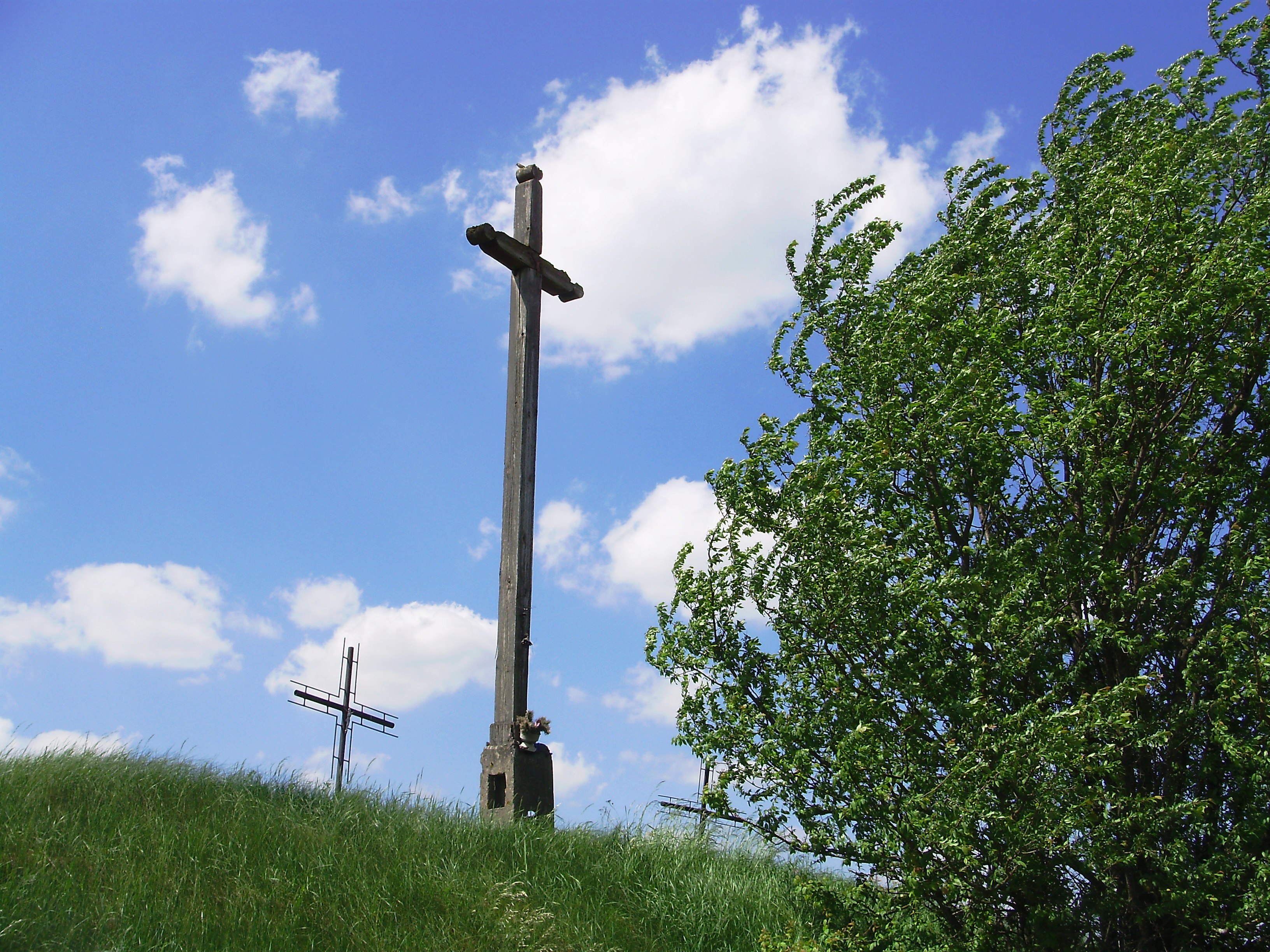
The mounds are located on a low hill in the fork of the road, both branches of which lead from Uścianki to Jeziorki. Just abroad with my native village. They are overgrown with grass and a shrubby tree grows at the foot of the hill. The outlines of individual graves are no longer visible. There are three crosses in the grave. In the middle stands a tall cross made of wood. A talented carpenter had to make it, as evidenced by the remains of ornaments on the shoulders and the top. From the remainder of the chamfer it can be concluded that they could be in the shape of a heart or a rounded leaf. From the bottom, the cross was profiled. It must have been rotting and therefore has been secured with a concrete platform. It is not known exactly when and by whom it was made. Earlier he stood at the Grochowski estate. It was moved to the graves in the 1970s by Józef Grochowski and his son Stanisław and placed in the place of the previous cross. The remains of his predecessor were buried in the graves. The old cross was once tall, but it decayed over the years, so the rotting part of the pole was cut off one by one so that at the end of his standing he was very small. It was hewn from a tree and his arms - says Edward Grochowski, who was a child at the time - had wooden knobs . The villagers recall that during its burying, human skulls were found. Jaws preserved in the ground pointed to the young age of those resting there. The buried cross, they said, could have been 250 years ago.

On both sides of the wooden cross are currently two modern small metal crosses. Over ten years ago, Stanisław Prawdzik from Uścianki, who lived nearby, put them in this place. He remembers that formerly, just before St. Antony, people came here to pray and sing religious songs. This custom ceased after the church in Żarnowo was built. People still give glory to the cross, as evidenced by the flowers that decorate it. In the Inventory of Monuments of the Augustów Commune located in the Commune Culture Center in Żarnowo I found the message that the cemetery is dated to 1800, and the wooden cross on it, known as a memorial, is to be from 1911.

How many secrets are hidden in this grave hill and wooden cross guarding the mortal remains of people once buried here.

Artykuł ukazał się w czasopiśmie Martyria 2/2015
Opublikowano Dodaj komentarz

From the history of the Bargłów church

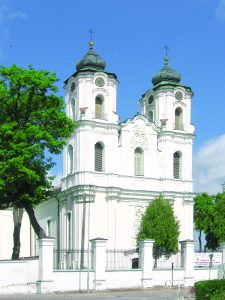
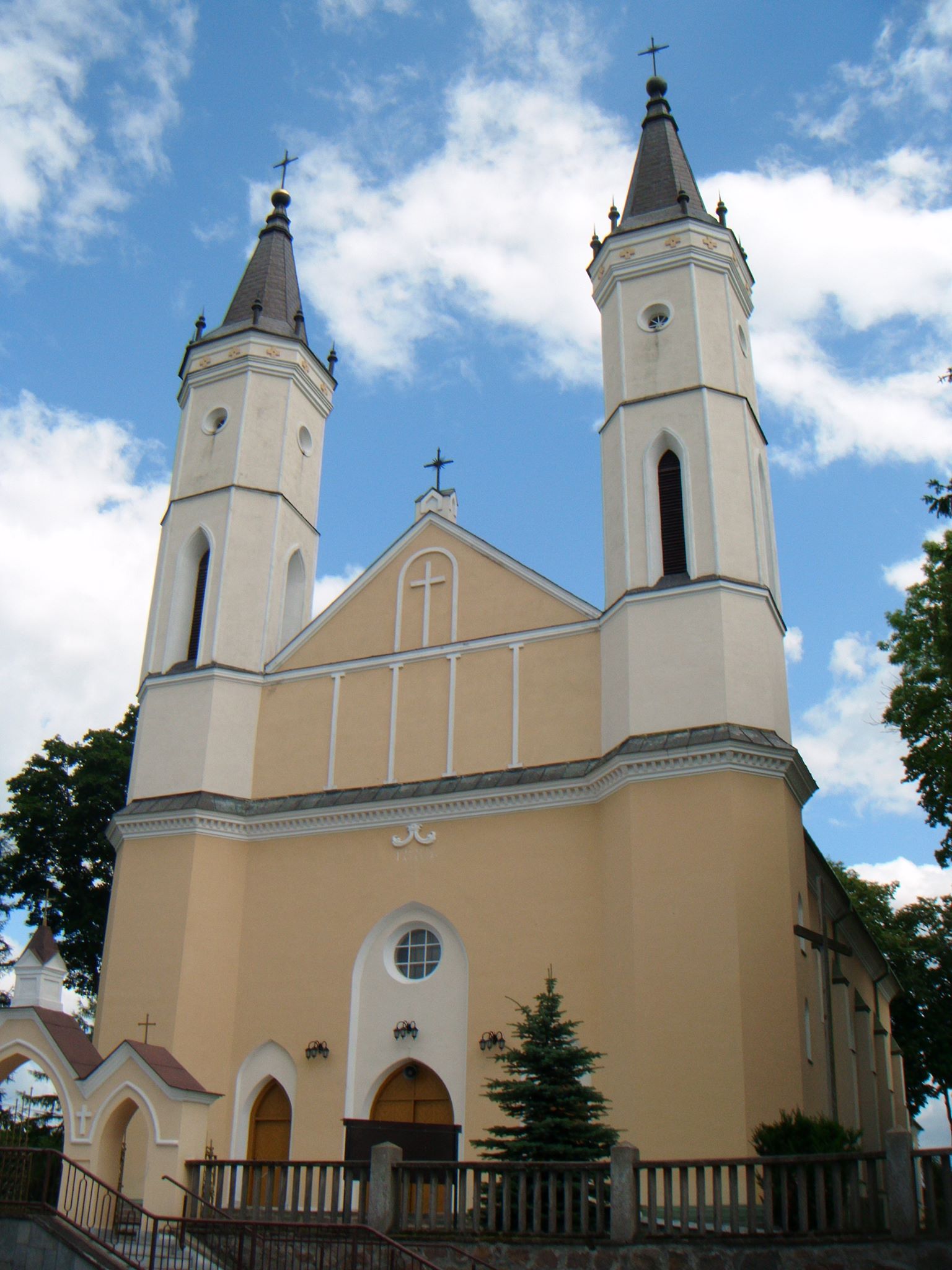
Various versions of the history of the brick church in Bargłów are given. I quote the one I traced, reading into the documentation available to me on this topic. In The Chronicle of the Royal Bargłów Parish written by the late Józef Golubiewski, we read in 1838 that the then priest was building a stone church. The chronicler also gives the church dimensions: length 30.5 m, width 12.5 m. It has a burnt brick floor, a wooden ceiling and a roof covered with tiles. This information is confirmed in The Inventory made on September 7, 1838 after the death of priest Klemens Ratokle, builder of that church. It also says that the temple is unplastered and unfinished inside, so it is not possible to hold any services in it. Still, although in very poor condition, the wooden church is open. A detailed description of the newly built brick church can be found in the documentation of the general visit to the parish from 1839. We read in it that the church has twelve windows, six doors, including one double (in the front from the road side, entering Babiniec with an iron lock). The windows in the sacristy and treasury are fitted with iron bars. There are two domes on the church. One of them, containing a bell, is above the high altar, it is finished with an iron cross three cubits high. The second, from the front, is crowned with an iron cross with a brass knob one cubit higher than the previous one. The length of the church is fifty-one Warsaw cubits, and twenty-one cubits width. There is a pulpit inside the temple made of carpentry lumber.

Post-visit documentation also informs that the church is built at the expense of the Government and the Parish. The Inventory from May 5, 1840, signed, among others by the dean of Augustów, father Paweł Makowski and father Aleksander Grudziński, the new Bargłów parish priest, states that the services are still held in the old church, which is eligible for demolition, because the new church in internal order is not finished yet. There is only the pulpit and three menzas without altars. Prepared due to the transfer of the former head of the Bargłów parish Fr. Jerzy Maciukiewicz to another parish, the Inventory of January 10, 1872, states that the brick church built thirty years ago is in poor condition. It threatens a sad accident. His current condition is the result of constant infiltration, from which rafters, beams and soffit inside the church have come to an end. The brick floor in the presbytery and nave was also partially damaged. In place of it, a floor of 1.5-inch boards was laid. This inventory accurately describes the altars found. There are three of them, just like in the previous wooden church. The great altar made of wood last year (by carpentry and woodcarving work), reworked and enlarged. It was painted white varnish and partly gilded. There is also a similar tabernacle on which a lamb with an apocalyptic book is placed, partly gold-plated and silver-plated. This altar has a stone menza and canvas antepedium and one cornice made of sawn timber. It houses a new painting of Our Lady of Częstochowa, oil-painted on a wooden board and framed in gilded frames.

Side altars, like the great one, are set on stone menzas with one step and made of the same material and enlarged by one floor. The first of them has a frontal with flowers. There are three paintings in it: St. John, St. Anna and the Lord Jesus Nazarene. Saint Anna's was painted on paper, while the other two were painted on canvas. All three paintings are framed in gilded frames. Previously hanging image of the Virgin in this altar is placed above the sacristy. The second side altar houses a painting of St. Antoni with gilded frames, decorated with a silver dress and a silver crown. It was moved to this place from the great altar. Placed above it there is also a painting of St. Of Archangel Michael in gilded frames, oil-painted on canvas. On all three altars, instead of old wooden and black polished, there are factory-made crosses with gilded figures of the Lord Jesus and canons under the glass. The church includes the newly varnished pulpit, three confessionals and eight benches. The Inventory also informs that in the frames on the front of the church were placed large, woodcarving work figures of saints Peter and Paul. I could not find anywhere the name of the building architect or builder.

The aforementioned chronicler and copyist of documents Józef Golubiewski, states in the chronicle he has prepared and here cited that Fr. Tadeusz Skarżyński built a stone church in 1883 on the site of the previous temple. Apparently, the previous one fell into further ruin, so it was decided to build a new one in its place. In published in 1880 Dictionary of the Kingdom of Poland and other Slavic countries in the description of the town of Bargłów Kościelny we can read: A new brick church is being built here, built from parishioners' contributions valued at 50,000 rubles. Prepared by the church builder, Fr. Tadeusz Skarżyński, a report sent in August 1888 to the head of the Augustów poviat says that for the construction of the temple 34,714 rubles and 78 kopecks were received.

Some historians say that the current stone church is the same church that was built in the 1830s. In the conservation documentation, I met with both information, such that the existing church was built in 1833, and other, that it was built in 1883. This second date is confirmed by the Inventory of the Parish Church in Bargłów from 1929. I quote: The church in Bargłów is parish, vernacular, brick, built in 1883, thanks to the efforts of priest Tadeusz Skarżyński, then the administrator of the parish [...]. It is also shared by released in 1975 The Jubilee Schema of The Łomza Diocese.

I think they were two different buildings, which I tried to show by citing the above documents. However, the case is open. Studies of historians may confirm this thesis in the future, or refute it. The history of the current temple is a material for another text.

The article appeared in the journal Martyria No. 5/2016